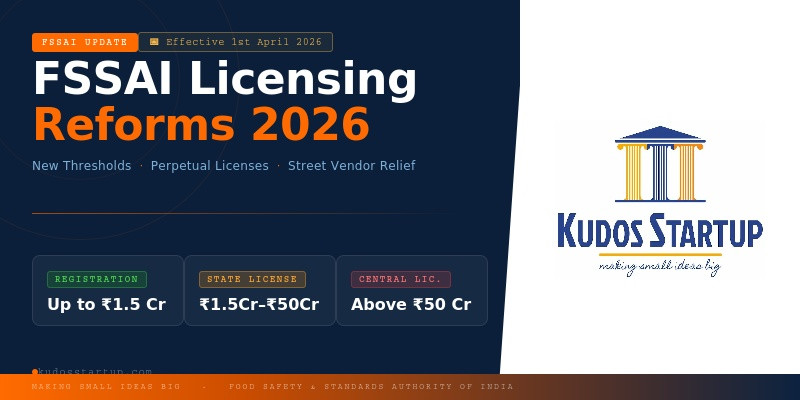
The Food Safety and Standards Authority of India (FSSAI) has rolled out one of the most significant overhauls to food business licensing and registration in recent years. Through the Food Safety and Standards (Licensing and Registration of Food Businesses) Amendment Regulations, 2026 — gazetted on 10th March 2026 — and a subsequent order dated 13th March 2026, FSSAI has introduced reforms that affect every food business operator (FBO) in India.
On 27th March 2026, FSSAI also released an official FAQ document to help FBOs and field officers understand exactly how these changes apply. This article compiles everything you need to know — with all questions answered directly using FSSAI's own clarifications.
The Four Key Reforms at a Glance
FSSAI's 2026 amendment introduces four major changes:
- Revised turnover thresholds for Registration, State License, and Central License
- Perpetual validity of all FSSAI licenses and registrations
- Deemed registration for street food vendors already registered under the Street Vendors Act, 2014
- Risk-based inspection framework replacing routine blanket inspections
All changes are effective from 1st April 2026.
Reform 1: Revised Turnover Thresholds — Which Category Does Your Business Fall Under?
The most immediate change for most food businesses is the revised turnover threshold for categorisation:
| Category | Annual Turnover | Typical Businesses |
|---|---|---|
| Registration | Up to ₹1.5 crore | Home kitchens, small vendors, petty food manufacturers, street food sellers |
| State License | Above ₹1.5 crore and up to ₹50 crore | Mid-size restaurants, regional food brands, catering companies, distributors |
| Central License | Above ₹50 crore | Large food corporations, pan-India manufacturers, importers/exporters |
These thresholds apply to all FBOs applying for new licenses or registrations on or after 1st April 2026. For existing FBOs, FSSAI has confirmed that sufficient time will be provided for migration via FoSCoS (Food Safety Compliance System) to align with the revised thresholds.
Important: No extra fee for migration
FSSAI has clarified that no modification fee is applicable for FBOs migrating to a new category due to the revised turnover thresholds. If you currently hold a State License and become eligible for Registration under the new limits, the fee already paid against the State License will be adjusted against the registration fee.
Your license number won't change
Even if your category changes — say, from Central License to State License, or State License to Registration — your license or registration number remains the same. Migration is handled automatically by the FoSCoS system based on a self-declaration by the FBO, with no approval required from the licensing or registering authority.
Reform 2: Perpetual Validity — No More Renewal Headaches
One of the most welcome changes is the introduction of perpetual validity for all FSSAI licenses and registrations. Here is what this means in practice:
- Your license or registration will remain valid unless it is suspended, cancelled, or surrendered
- You are no longer required to renew your license or registration periodically
- You can pay the fee for any number of years at once, at any time of the year
- Any license or registration issued on or after 1st April 2026 will automatically carry perpetual validity
- Applications currently under process — whether in document scrutiny, reverted with a query, or at inspection stage — will also receive perpetual validity once issued after April 1
This applies to Tatkal licenses and registrations as well.
The key condition: while renewal deadlines go away, FBOs must continue to meet all hygiene, safety, and statutory compliance requirements. Perpetual validity is not a free pass — it simply removes the administrative burden of periodic renewal.
Reform 3: Street Food Vendors — Deemed Registration Under FSSAI
Street food vendors, hawkers, food carts, and food trucks who are already registered under the Street Vendors (Protection of Livelihood and Regulation of Street Vending) Act, 2014 will now be deemed to be registered under the Food Safety and Standards Act, 2006 as well.
This eliminates the earlier dual registration and dual fee requirement that affected millions of small food operators across India. Previously, vendors had to separately obtain FSSAI registration even if they were already registered under the Street Vendors Act — an unnecessary compliance burden that this reform removes entirely.
However, these vendors must still comply with the hygiene and sanitary requirements under Schedule 4 of the FSSAI Licensing and Registration Regulations, 2011. Food safety standards remain non-negotiable, even with simplified registration.
Reform 4: Risk-Based Inspections — Compliant Businesses Get Relief
FSSAI's new inspection framework moves away from blanket periodic inspections towards a computer-assisted, risk-based system. The system draws from multiple inputs including:
- Compliance history during enforcement
- Surveillance data
- Self-compliance testing records
- Third-party audits
The practical benefit for food businesses: compliant FBOs will face fewer inspections. The framework is designed to reduce repeated visits to businesses with clean records, while focusing attention on repeat non-compliant operators.
What about high-risk food categories?
FSSAI has specifically clarified that the increase in the Registration threshold does not dilute safety requirements for high-risk food businesses. Businesses manufacturing dairy products, meat, packaged drinking water, infant food, and fishery products must continue to comply with all applicable hygiene, safety, and testing requirements — regardless of their turnover category.
Impact on State Governments
With these reforms, FSSAI estimates that more than 98% of food businesses will now fall under the purview of State Governments. State food safety authorities will be responsible for monitoring, inspection, and quality control for the vast majority of FBOs. This is a significant devolution of regulatory responsibility to the state level.
There is no change in the jurisdiction of licensing or registering authorities — only the thresholds that determine which authority is relevant have been updated.
Key Dates Summary
| Date | Event |
|---|---|
| 10th March 2026 | Amendment Regulations gazetted |
| 13th March 2026 | FSSAI order on revised turnover thresholds issued |
| 27th March 2026 | Official FAQ document released |
| 1st April 2026 | All reforms come into effect |
Action Checklist for Food Business Operators
Before April 1, 2026:
- Calculate your annual turnover and identify which category applies to you under the new thresholds
- Check if your current FSSAI license category has changed
- If migrating to a new category, no fee is needed — the system handles it via self-declaration on FoSCoS
- If your fee has already been paid for a higher category, confirm the adjustment with your compliance consultant
- Ensure all your business details and contact information on FoSCoS are current
If you are a street food vendor: 6. Check whether you are already registered under the Street Vendors Act, 2014 — if yes, your FSSAI registration is now deemed, with no separate application needed 7. Ensure you are meeting Schedule 4 hygiene and sanitary requirements
For all FBOs: 8. Note that you no longer need to track renewal deadlines — but stay compliant with hygiene, safety, and other statutory obligations to avoid suspension or cancellation
Frequently Asked Questions (Based on FSSAI's Official FAQ, March 27, 2026)
Will my existing license be cancelled because of the new thresholds? No. Existing licenses remain valid. Migration for existing FBOs will be facilitated through FoSCoS, with sufficient time provided. No approval is required — the system handles the category change automatically based on your self-declaration.
Do I need to pay any fee to migrate to a new category? No modification fee is charged for migration due to revised turnover thresholds. If you have already paid for a higher category, that fee will be adjusted.
My application is still under process. What happens after April 1? Any license or registration issued on or after 1st April 2026 — regardless of when the application was filed — will carry perpetual validity.
Does my license number change when my category changes? No. Your license or registration number stays the same even if your category changes.
I am a street food vendor. Do I need a separate FSSAI registration now? If you are registered under the Street Vendors Act, 2014, you are deemed registered under FSSAI. No separate FSSAI registration is required. However, you must comply with Schedule 4 hygiene requirements.
Will there be fewer inspections under the new framework? Compliant businesses will benefit from reduced inspection frequency under the risk-based model. Non-compliant businesses will continue to face scrutiny.
In Summary
FSSAI's 2026 reforms are a meaningful step towards a more practical, proportionate, and business-friendly regulatory environment for India's food sector. The higher turnover thresholds reduce compliance burden for smaller operators. Perpetual validity removes renewal anxiety. Deemed registration relieves street vendors of duplicate paperwork. And risk-based inspections reward good compliance behaviour.
The changes take effect in days — review your category and update your records before April 1, 2026.
Navigating FSSAI compliance for your food business? The team at Kudos Startup helps food businesses get licensed, stay compliant, and grow without regulatory roadblocks. Get in touch today.